

 |
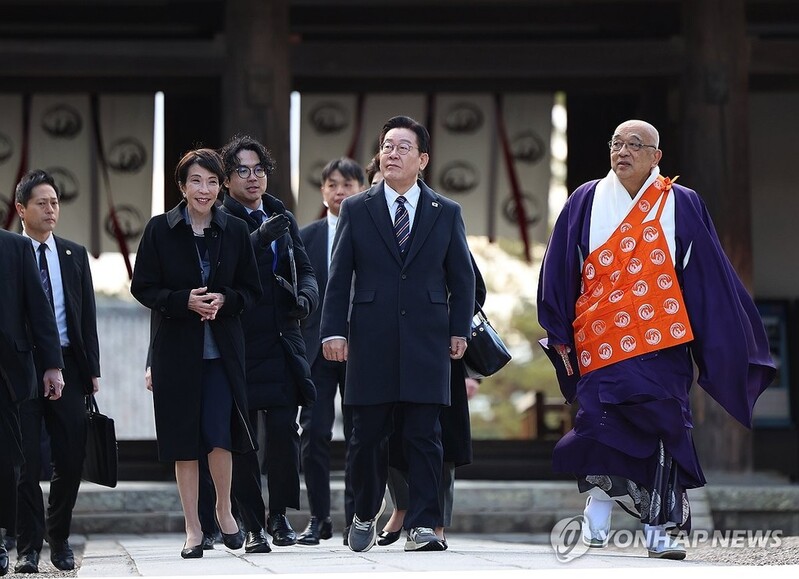
| ▲ South Korean President Lee Jae Myung (2nd from R) and Japanese Prime Minister Sanae Takaichi (2nd from L), accompanied by Shokaku Furuya, chief of Horyu-ji, a World Heritage-listed Buddhist temple founded in the seventh century, tour the temple in Nara Prefecture, western Japan, on Jan. 14, 2026. (Yonhap) |
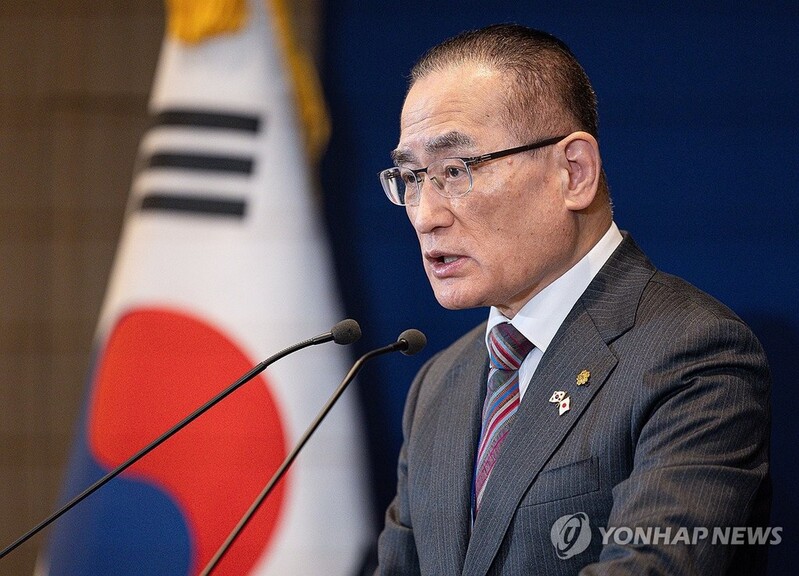 |
| ▲ National Security Adviser Wi Sung-lac explains the outcome of President Lee Jae Myung's summit with Japanese Prime Minister Sanae Takaichi during a press briefing held at a hotel in Osaka on Jan. 14, 2026. (Yonhap) |
(LEAD) security adviser-Japan
(LEAD) S. Korea reaffirms bid to join trans-Pacific trade pact at Lee-Takaichi summit
(ATTN: ADDS remarks, details, photo)
By Kim Eun-jung
NARA, Japan, Jan. 14 (Yonhap) -- South Korea has reaffirmed its bid to join the trans-Pacific trade pact during the summit talks between President Lee Jae Myung and Japanese Prime Minister Sanae Takaichi, Lee's top security adviser said Wednesday.
National Security Adviser Wi Sung-lac told reporters that relevant government departments were expected to discuss the matter to join the 12-member Comprehensive and Progressive Agreement for Trans-Pacific Partnership (CPTPP).
During the Lee-Takaichi summit, South Korea and Japan also discussed Seoul's ban on seafood from eight Japanese prefectures imposed after the 2011 Fukushima nuclear disaster, Wi said.
With regard to South Korea's ban on seafood imports from Japan, Wi said, "There was an explanation from the Japanese side about food safety."
Wi said the South Korean side "listened to this explanation."
Before the summit with Takaichi, Lee told Japan's NHK public broadcaster that the issue of South Korea's ban on seafood imports from eight Japanese prefectures needs to be addressed "over the long term," because it requires the trust of the Korean people.
South Korea imposed the ban in 2013 over radiation concerns following the 2011 Fukushima nuclear disaster and has vowed to keep the restrictions in place until public concerns are fully eased.
Supply chain issues were on the agenda as the meeting came days after China imposed restrictions on exports of "dual-use" items with potential military applications to Japan, raising concerns that Beijing could potentially choke off supplies of rare earth minerals critical to high-tech manufacturing.
During the talks, the two leaders shared a consensus on cooperation in establishing stable supply chains, Wi said, without going into details about whether they specifically discussed Beijing's export controls.
While the two leaders discussed ways to bolster trilateral cooperation with Washington, the issue of three-way cooperation with Beijing was also raised, Wi said, adding that the discussions were not "targeted at any specific country."
Their summit, the second in less than three months, also produced progress on historical issues stemming from Japan's 1910-45 colonial rule of Korea.
Seoul and Tokyo agreed to conduct DNA analysis to identify remains discovered last August at the Chosei undersea coal mine in Japan's Yamaguchi Prefecture, where a flood in 1942 killed 183 people, including 136 Korean forced laborers.
The issue of the Chosei coal mine was the first item raised by Takaichi during Tuesday's talks, Wi said, noting the two leaders agreed to "strengthen humanitarian cooperation related to historical issues."
(END)
(C) Yonhap News Agency. All Rights Reserved