

 |
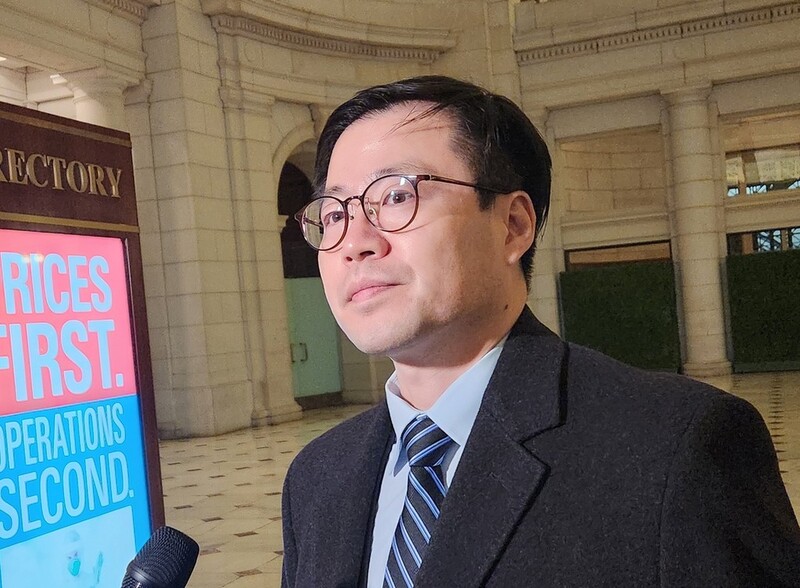
| ▲ Trade Minister Yeo Han-koo speaks to the press at a train station in Washington on Jan. 14, 2026. (Yonhap) |
trade minister-US visit
S. Korea to seek 'optimal' response in case of ruling against Trump's 'reciprocal' tariffs: Seoul official
By Song Sang-ho
WASHINGTON, Jan. 14 (Yonhap) -- South Korea would seek an "optimal" response while watching other countries' moves, should the U.S. Supreme Court rule against President Donald Trump's broad country-specific tariffs, a senior Seoul official said Wednesday, stressing the Asian country is preparing for "all possibilities."
Trade Minister Yeo Han-koo made the remarks in a meeting with reporters in Washington as the high court has been deliberating on the legality of Trump's use of the 1977 International Emergency Economic Powers Act (IEEPA) to impose "reciprocal" tariffs on most trading partners, including South Korea, the European Union and Japan.
Yeo had planned to head back to South Korea on the day but delayed his flight to examine potential ramifications from a proclamation that Trump signed on Wednesday to levy a 25 percent tariff on certain semiconductors for artificial intelligence (AI).
"While watching how other countries with (trade) agreements with the U.S. would respond, (South Korea) would need to explore an optimal judgment depending on how the situation would play out," Yeo told reporters, addressing a question over how Seoul would move in the event of a ruling against IEEPA-based tariffs.
The minister added that during his stay in the U.S. capital, he had felt that the Trump administration has a "strong" will to use all tools available to maintain its tariff policy even if the court hands down a ruling against the tariffs.
He pointed out that there are various predictions as to whether the court would rule in favor of or against IEEPA tariffs, with the ruling seen as a "50-50" call.
"So it is, in fact, difficult to make a prediction," he said, noting that experts in Washington think that a court decision could come at any time.
Observers have said that a court ruling against reciprocal tariffs might trigger what could be a complicated process for companies to receive tariff refunds.
On this issue, Yeo said that the Seoul government is making preparations for all possibilities.
Even if the ruling is against IEEPA tariffs, the Trump administration is expected to leverage other legal authorities or means at its disposal to continue tariff collection.
Yeo said that Section 301 of the 1974 Trade Act -- used for country-specific tariffs against trade violations -- might be the "most useful" tool for the Trump administration, while other options are also available, including Section 338 of the 1930 Tariff Act for duties against countries with trade practices discriminating against the U.S.
Commenting on Trump's proclamation on chip tariffs, the minister said that he would seek to examine the document to see if there would be any impact on South Korean chipmakers.
"It is premature to say anything for now as we are in the process of exhaustively looking at (the proclamation)," he said. "(The industry ministry) headquarters in collaboration with the industry are analyzing (a potential impact on Korean businesses)."
Under the proclamation, the U.S. plans to apply a 25 percent tariff on certain AI chips, which are imported into the U.S. and then reexported to other countries, but the levy does not apply to chips for use in U.S. data centers or for non-data center consumer applications in the U.S.
Trump has been using tariffs to increase federal revenue, boost domestic manufacturing and bring in foreign investments.
(END)
(C) Yonhap News Agency. All Rights Reserved