


 |
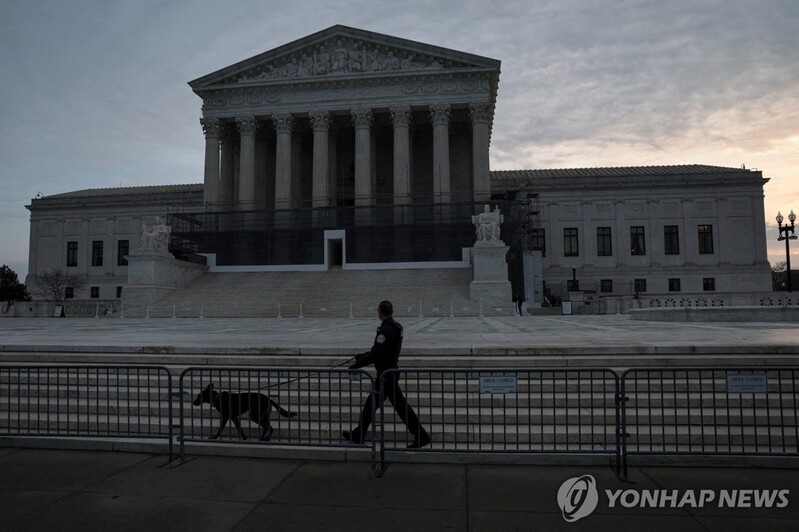
| ▲ This file photo, released by Reuters, shows a U.S. Supreme Court Police canine unit patrolling in front of the court building in Washington on Jan. 9, 2026. (Yonhap) |
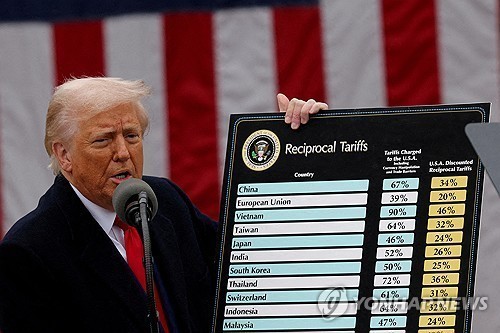 |
| ▲ This file photo, released by Reuters, shows U.S. President Donald Trump delivering remarks on tariffs in the Rose Garden at the White House in Washington on April 2, 2025. (Yonhap) |
US court-tariff ruling
U.S. Supreme Court holds off again on ruling on legality of Trump's 'reciprocal' tariffs
By Song Sang-ho
WASHINGTON, Jan. 14 (Yonhap) -- The U.S. Supreme Court did not issue a ruling on Wednesday on the legality of President Donald Trump's "reciprocal" tariffs on America's trading partners, including South Korea, despite expectations that the decision would come as early as this week.
As the court announced a plan earlier to convene a public session, speculation arose that it could rule on the legality of Trump's use of the International Emergency Economic Powers Act (IEEPA) of 1977 to impose the country-specific tariffs. The court does not announce in advance which rulings it will issue.
On its website, the court did not issue a ruling on the tariff case, though it announced its decisions in three other cases.
Business leaders, policymakers and others had been closely waiting for the tariff ruling as it could have far-reaching ramifications for global trade.
The Trump administration has imposed 15 percent reciprocal tariffs on Korean products, down from 25 percent, in accordance with a bilateral trade and investment deal under which Seoul has committed to investing US$350 billion in the United States, among other pledges.
In August, a federal appeals court ruled that the IEEPA tariffs in question exceeded presidential authority, affirming a lower court's decision in May.
Trump has warned that losing his administration's ability to tariff countries that treat the U.S. unfairly would be a "terrible blow" to the U.S.
He also said that if the high court decision against the global tariffs, the U.S. may have to pay back "many hundreds of billions of dollars," and that the total amount could rise to "trillions of dollars" when countries and companies call for a "payback" for the investments they have made in the U.S. to avoid tariffs.
In April, Trump announced his plans for reciprocal tariffs, saying he would use import taxes to curtail America's trade deficits, boost revenue, attract foreign investment and strengthen domestic manufacturing.
(END)
(C) Yonhap News Agency. All Rights Reserved