


 |
| ▲ Officials from the Donggureung management office cut silver grass covering the burial mound of Geonwolleung, the tomb of Joseon founder King Taejo Yi Seong-gye, during a traditional grass-cutting ceremony at Donggureung in Guri, Gyeonggi Province, on April 6, 2026. The silver grass is said to have been brought from Hamheung and planted on the mound in accordance with Taejo's dying wish. (Yonhap) |
SEOUL, Oct. 19 (Yonhap) -- What better way to enjoy the autumn atmosphere than to stroll around Geonwolleung, the tomb of Taejo Yi Seong-gye (reigned 1392-1398), founder of the Joseon Dynasty?
The Korea Heritage Service's Royal Palaces and Tombs Center said Monday that it will specially open the burial area of Geonwolleung, located in Donggureung in Guri, just east of Seoul, from Nov. 3-8.
Geonwolleung is the only one of the Joseon royal tombs, a UNESCO World Heritage site, whose burial mound is covered with silver grass.
The silver grass is said to have been brought from Hamheung, Taejo's hometown, and planted at the tomb in accordance with his dying wish.
The burial area will be open twice a day, at 10 a.m. and 2 p.m.
Visitors will be able to explore the burial area, which is normally difficult to access, with a tour guide and learn more about the historical value and significance of the Joseon royal tombs.
Applications can be made through the state agency's royal palaces and tombs center's website (royal.khs.go.kr) starting at 10 a.m. Monday. Each session is limited to 20 participants, with a limited number of spots also available for on-site registration on the day.
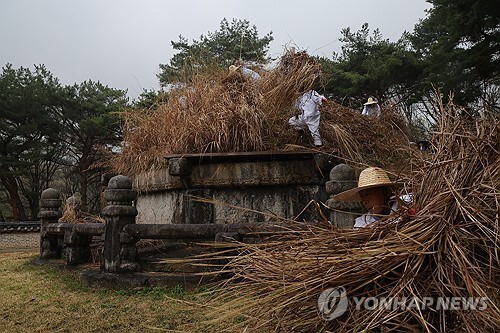 |
| ▲ Officials from the Donggureung management office cut silver grass covering the burial mound of Geonwolleung, the tomb of Joseon founder King Taejo Yi Seong-gye, during a traditional grass-cutting ceremony at Donggureung in Guri, Gyeonggi Province, on April 6, 2026. The silver grass is said to have been brought from Hamheung and planted on the mound in accordance with Taejo's dying wish. (Yonhap) |
The Joseon royal tombs are the burial sites of kings and queens, as well as emperors and empresses, constructed during the Joseon Dynasty (1392-1897) and the Korean Empire (1897-1910). They are regarded as the culmination of Joseon architecture and rituals.
A total of 40 royal tombs remaining in South Korea, including Geonwolleung, are inscribed as a UNESCO World Heritage site.
[Copyright ⓒ K-VIBE. All rights reserved. Unauthorized reproduction and redistribution are prohibited.]