


[Editor's note] Yonhap News Agency presents a series of feature articles on sustainable coexistence models and future strategies for South Korea and Central Asia, in line with the first Korea-Central Asia Summit, which will be held in Seoul on Sept. 16-17, 2026.
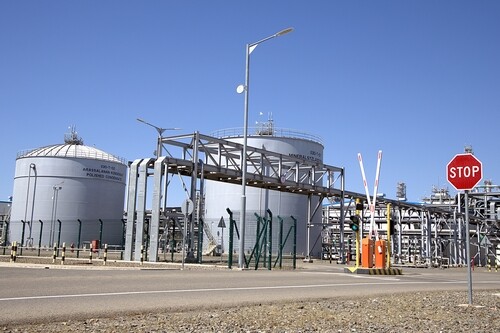 |
| ▲ The Kiyanly Polymer Plant, a major gas-chemical complex in western Turkmenistan, is seen on June 30, 2026. The plant has been shut down since April 2023, with inspections and normalization work currently under way to resume operations. (Yonhap) |
TURKMENBASHI, Turkmenistan, ALMATY, Kazakhstan, Sept. 11 (Yonhap) -- The Kiyanly Polymer Plant in western Turkmenistan on the Caspian Sea coast is a large gas-chemical complex built by a consortium of Hyundai Engineering Co., LX International Corp. and 124 South Korean small and medium-sized companies.
The plant was established to produce high-value petrochemical products from natural gas and began operations in October 2018. It was regarded as a representative project demonstrating the construction and technological capabilities of South Korean companies in Central Asia's high-value plant market.
But when reporters visited the site in late June, normal operations had been suspended. The huge pipelines and production facilities remained in place, but no products were being made at the plant. Its last normal operation was in April 2023, and inspections and restoration work are currently under way to restart the facility.
"It is not a design flaw but a problem that occurred during the operation of the machinery," said Dovran Alaberdiyev, chief engineer of the Kiyanly Polymer Plant. "About 300 people are working here, and only some processes involving seawater treatment are being maintained."
"A problem occurred in the cooling-water system that uses seawater, and it appears that changes in the composition of the seawater affected the system," he added. "We are considering introducing a system to monitor the composition of the seawater online around the clock to resolve the issue."
The facility was built as part of the world's fourth-largest holder of natural gas reserves' efforts to transform itself from a gas exporter into a gas-chemical industrial power. But the shutdown demonstrates that possessing natural resources and reliably processing them into industrial products are separate challenges.
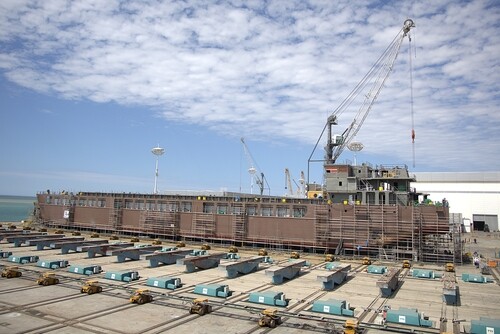 |
| ▲ The Balkan Shipyard on Turkmenistan's Caspian Sea coast is seen on June 30, 2026. The second of two 6,100-ton multipurpose cargo ships being built locally by Korea's Koryo Shipbuilding Industry Technology has reached 77 percent completion in the outfitting process. (Yonhap) |
◇ A stalled Kiyanly, a busy shipyard: Seeking a strategy in Turkmenistan
The atmosphere was different at the Balkan Shipyard, about a 30-minute drive along the Caspian coast from Kiyanly. About 700 workers, including more than 50 employees from South Korea's Korea Shipbuilding Industry Technology Co. (KSIT), were building ships at the sprawling facility.
The first of two 6,100-ton multipurpose cargo ships jointly built by South Korea and Turkmenistan was delivered in May. At the time of the reporters' visit, construction of the second vessel was under way, with outfitting about 77 percent complete.
"We are preparing to participate in the construction of follow-up vessels, including multipurpose cargo ships and combined cargo-passenger ships," KSIT Executive Vice President Son Kwang-mok said. "We are also working to modernize the Balkan Shipyard by applying robotic welding systems and automated production methods."
"One of the biggest opportunities we gained from the project was teaching South Korean shipbuilding technology to local workers," Balkan Shipyard Vice President Matdiyev Ejis said. "Local workers received three months of training from South Korean experts before being deployed to the shipbuilding site."
The next step is localization of equipment and materials. Many items needed for shipbuilding, including piping, are currently manufactured in South Korea and transported to Turkmenistan. But KSIT and the Balkan Shipyard are working to establish local facilities for pipe manufacturing and galvanizing in the future.
Once a local piping production base is established, the companies could also consider supplying equipment and materials to shipbuilding industries in Caspian countries such as Kazakhstan and Azerbaijan over the longer term.
If Kiyanly's challenge is restarting operations, the Balkan Shipyard's challenge is achieving self-reliance. The two sites demonstrate in different ways that building facilities locally is not enough; operations after completion, technology transfer and the creation of local supply chains are also crucial.
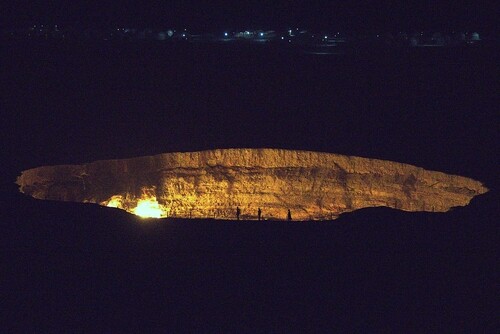 |
| ▲ Darvaza Gas Crater, a crater often called the "Shining of Karakum" and "Gate of Hell," symbolizes resource-rich Turkmenistan, the fourth largest country in the world's natural gas reserves. The crater is seen in the Karakum Desert in early July 2026. The giant pit has been burning continuously since 1971. (Yonhap) |
◇ Difficulty importing Turkmen natural gas makes local processing a practical alternative
Turkmenistan's natural gas is an attractive resource for South Korea, but bringing it into the country is not easy. Transporting natural gas from landlocked Turkmenistan to South Korea would require consideration of transportation routes involving existing pipelines, neighboring countries and the Caspian Sea, as well as economic feasibility.
From South Korea's perspective, therefore, industries that convert natural gas locally into high-value products, such as gas chemicals, fertilizers and plant facilities, could be a more practical alternative than importing the gas itself.
Daewoo Engineering & Construction Co.'s fertilizer plant project in Turkmenistan is also linked to this approach. Producing fertilizer and other industrial products from natural gas locally can leave greater added value in the country than simply exporting the raw material.
However, as the Kiyanly case shows, building a plant does not mark the end of a project. The supply of raw materials, operation and maintenance, parts procurement, skilled personnel and markets for finished products must be linked together organically for the business to be sustainable.
There are calls locally for South Korean companies to go beyond EPC contracts covering the entire design, procurement and construction process and expand their business scope to include maintenance, technology transfer and training of local workers.
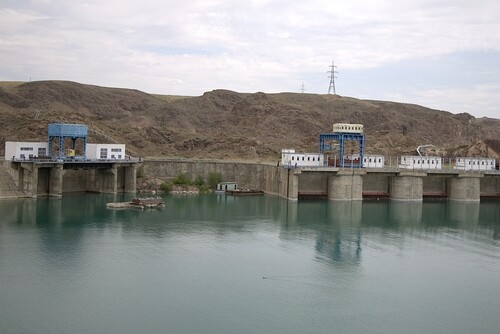 |
| ▲ The Kapchagai Hydroelectric Power Plant and its artificial reservoir north of Almaty, Kazakhstan, are seen on June 21, 2026. Built by damming the Ili River, the key water facility serves multiple purposes, including irrigation in Almaty region, hydropower generation, and water supply for cities and industries. (Yonhap) |
◇ Kazakhstan's solar power shines beside hydropower, with China's presence visible everywhere
Another transformation in Central Asia's energy industry can be seen around Konayev, formerly Kapchagay, in Kazakhstan's Almaty region.
Hydroelectric facilities using the waters of the Ili River have long supported the power grid, but solar and wind power facilities have recently been springing up around them.
The Nurgis 100-megawatt solar power plant in the Konayev area visited by reporters was one such facility. More than 303,000 solar panels, each with a capacity of 330 watts, had been installed across a vast 270-hectare site.
Owned and operated by Chinese renewable energy company Universal Energy, the plant demonstrates that China has moved beyond simply supplying equipment and is making deeper inroads into Central Asia's energy market, including power generation and operations.
Kazakhstan is also rich in wind resources. Solar and wind power have been rapidly added to the country's traditional reliance on hydropower and thermal power.
The challenge is intermittency. As the share of solar and wind power increases, the importance of energy storage systems, or ESS, that store electricity for supply when needed and smart grids that adjust power generation in real time also grows.
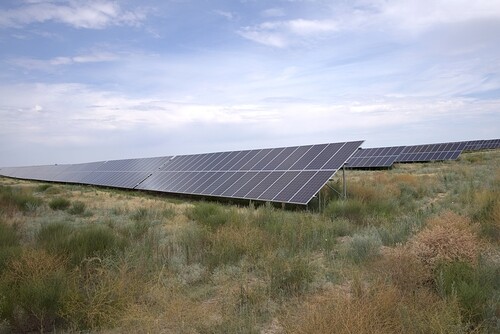 |
| ▲ The Nurkisa 100-megawatt solar power plant near Konayev, Kazakhstan, is seen on June 21, 2026. It is owned and operated by Universal Energy, a Chinese renewable energy company. (Yonhap) |
"We plan to add 26.3 gigawatts of total power generation capacity by 2035, with about 31.4 percent allocated to flexible and adjustable generation facilities capable of responding to changes in demand," a Kazakhstan Energy Ministry official said.
"We will introduce battery storage systems totaling more than 3 gigawatt-hours for large-scale renewable energy projects," the official added. "We are also pursuing a system requiring some large renewable energy projects to equip themselves with storage facilities equivalent to a certain percentage of their generation capacity."
This is also an area in which the Kazakh government is showing interest in South Korean companies.
The Energy Ministry said it highly values South Korean smart-grid and ESS technologies and expressed an interest in pursuing technology localization and business-to-business pilot projects in power-grid digitalization, renewable energy equipment and storage systems.
With Chinese companies already having secured a foothold in solar power generation, analysts say a more realistic strategy for South Korea would be to target markets that emerge after the expansion of renewable energy, such as ESS, smart grids and digital power-grid operations, rather than competing on the price of solar panels.
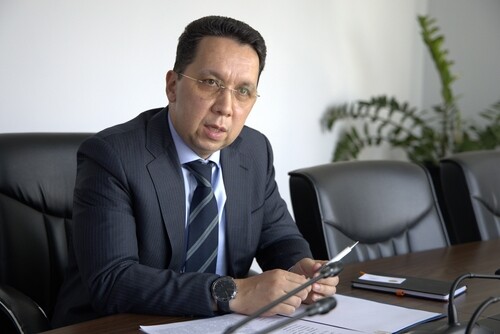 |
| ▲ Vasily Lavrenov, deputy chairman of Kazakhstan's Atomic Energy Agency, speaks in an interview with Yonhap News Agency at the agency's office in Astana on June 22, 2026. (Yonhap) |
◇ Technology alone not enough to win nuclear power projects, but room for cooperation remains
Nuclear power is perhaps the most symbolic part of Kazakhstan's energy transition, but it is a difficult market for South Korea to enter.
Kazakhstan is important not only as a potential market for nuclear power plants but also as a major player in the global nuclear fuel supply chain. An official from state-run uranium producer Kazatomprom said Kazakhstan accounts for about 40 percent of global primary uranium production.
Kazatomprom said it is expanding the Trans-Caspian International Transport Route, or TITR, known as the Middle Corridor, alongside the existing northern transport route through St. Petersburg, Russia. This means nuclear power projects, nuclear fuel and logistics all need to be viewed from the perspective of energy security.
South Korea has sought to expand its presence in the Kazakh market with its APR1400 reactor. Its experience building the Barakah nuclear power plant in the United Arab Emirates within the scheduled construction period and budget is considered a strength.
Regarding South Korea's failure to win out over Russia in the competition to build Kazakhstan's first nuclear power plant in the Balkhash region, Vasily Lavrenov, deputy head of Kazakhstan's Atomic Energy Agency, said, "South Korea was not excluded because it lagged behind competing countries in terms of safety or technology."
Nuclear power projects are not decided solely by reactor performance. Financing terms, localization, workforce training, supply chains, long-term maintenance and strategic relations between countries all play a role.
Kazakhstan is situated between Russia and China, both global nuclear power suppliers. In addition to geographic proximity, the two countries can offer packages combining financing, supply chains and existing industrial cooperation, making it difficult for South Korea to overcome this structure with the technological strengths of the APR1400 alone.
Local government officials say South Korea does not necessarily need to focus only on winning contracts for key nuclear equipment. There is also potential for cooperation in safety and control systems, auxiliary equipment, power grids and workforce training.
The importance of operations and maintenance is also reflected in the research priorities of local researchers.
Janat Makhatayeva, a senior data scientist at Nazarbayev University's Institute of Smart Systems and Artificial Intelligence, said robots and sensors could be used to inspect high-temperature and hazardous workplaces, stressing that competitiveness in energy infrastructure is expanding to include continuous monitoring and preventive maintenance technologies.
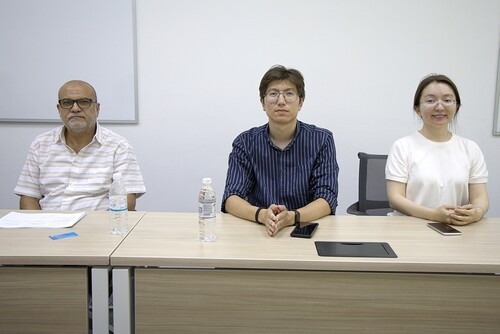 |
| ▲ Researchers from Nazarbayev University's Institute of Smart Systems and Artificial Intelligence (ISSAI) speak about Kazakhstan's energy and industrial policies at their laboratory in Astana on June 23, 2026. From L: Professor Amgad Salama, senior scientists Akilbek Maksutov and Zhanat Makhataeva. (Yonhap) |
◇ From winning contracts to what comes after construction: Stable operations and mutual growth as new strengths
Turkmenistan has abundant natural gas, but there are limits to bringing it to South Korea. Even if a gas-chemical plant is built, industrialization can only follow if stable operations are maintained.
In Kazakhstan, Chinese companies have already secured control of much of the renewable energy market. In nuclear power, South Korea must overcome the geopolitical and financial advantages enjoyed by Russia and China.
It would be difficult for South Korea to compete with these countries on the scale of capital or geographic proximity.
Instead, an alternative could be to combine South Korea's experience in plant design and construction with financing, operations and maintenance, ESS and smart-grid technologies, and digital technology.
At Kiyanly, the challenge was restarting a facility that had already been completed, while at the Balkan Shipyard, the focus was on developing the capacity to build ships and equipment locally.
South Korea's place in Central Asia's energy market is not limited to winning a single gas-field or nuclear power contract. The ability to operate facilities reliably over the long term after construction and, in the process, develop local workers and industries together is emerging as a new competitive advantage.
*This feature was supported by the Korea Press Foundation with funds raised through government advertising fees.*
[Copyright ⓒ K-VIBE. All rights reserved. Unauthorized reproduction and redistribution are prohibited.]